 F-14/15, Orbit Mall, Civil Lines, Jaipur-302006
 support@thetaxheaven.com
F-14/15, Orbit Mall, Civil Lines, Jaipur-302006 support@thetaxheaven.comCryptocurrency Tax Rules in India 2026: What Every Investor Must Know Before Filing ITR
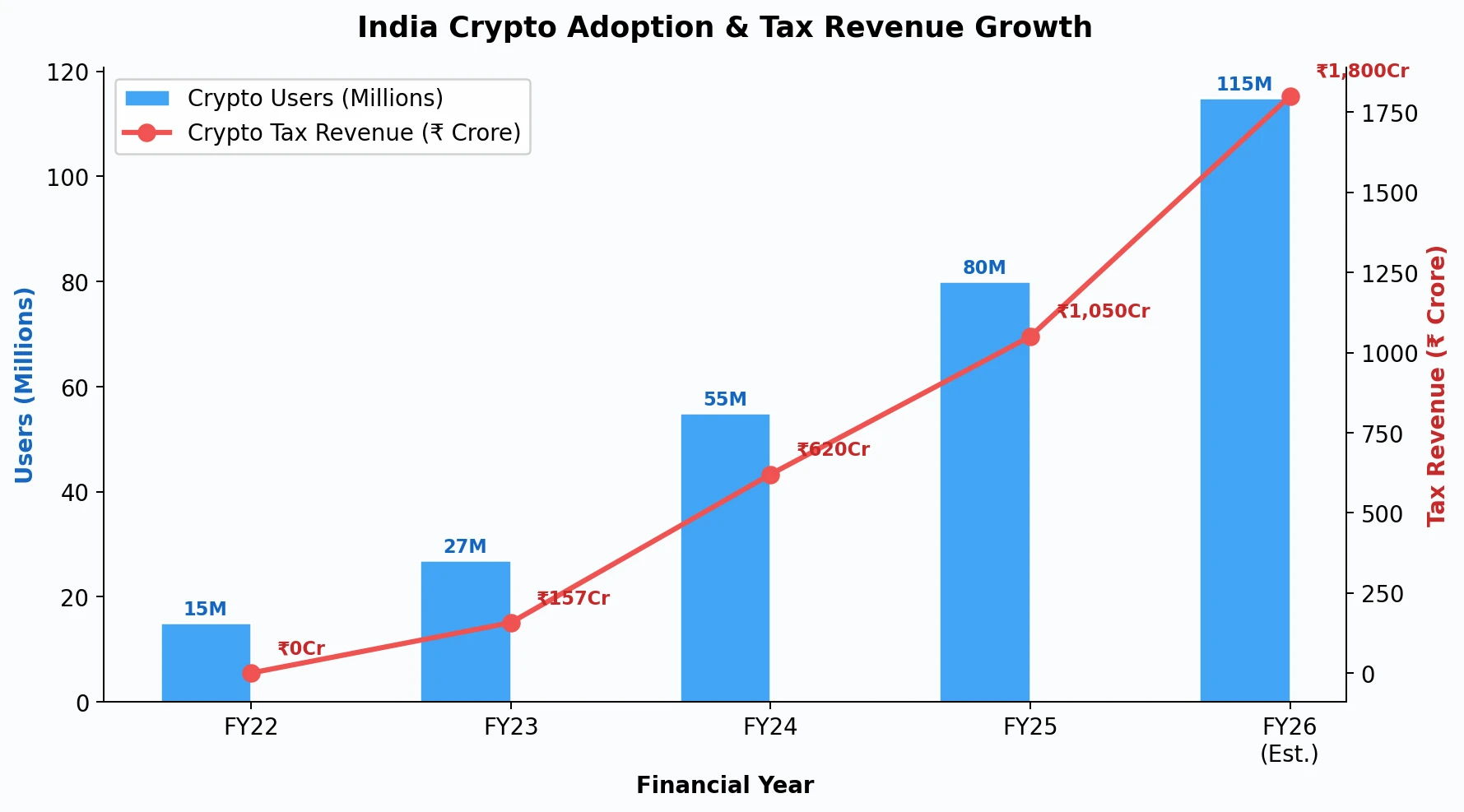
India now has over 100 million cryptocurrency users. Yet when ITR filing season arrives each year, a significant portion of these investors either misreport their digital asset income or skip it entirely — not out of malice, but out of genuine confusion about how the rules work.
And the confusion is understandable. The cryptocurrency tax framework introduced in the Finance Act 2022 was India’s first attempt at codifying digital asset taxation, and it created a regime unlike anything else in the Income Tax Act. No loss offsets. No deduction for expenses other than acquisition cost. A flat 30% rate regardless of your income slab. For investors accustomed to the relatively favourable treatment of equity and mutual funds, the crypto tax rules feel punitive — and they require a fundamentally different approach to tax planning.
This guide breaks down exactly how cryptocurrency taxation works in India for FY 2025-26, what has changed, and how smart investors are adapting their strategies to minimise their tax burden within the bounds of the law.
The Core Framework: Section 115BBH
Section 115BBH, introduced in April 2022, governs the taxation of income from Virtual Digital Assets (VDAs) — the legal term that covers cryptocurrencies, NFTs, and other digital tokens. The key provisions are straightforward but harsh:
What Changed for FY 2025-26
While the core 30% rate remains unchanged, FY 2025-26 brought several developments that crypto investors need to be aware of:
ARCA-style reporting is coming to India. The Central Board of Direct Taxes (CBDT) has expanded the reporting requirements for cryptocurrency exchanges operating in India. Platforms must now report all user transactions, wallet balances, and withdrawal addresses to the tax department. If you traded on any Indian exchange — WazirX, CoinDCX, CoinSwitch, ZebPay — the Income Tax Department already has your transaction data.
International exchange compliance. Following the Financial Intelligence Unit’s enforcement actions in late 2024 and 2025, major international platforms including Binance, KuCoin, and MEXC now comply with Indian reporting requirements. The era of trading on offshore platforms to avoid reporting obligations is effectively over.
Potential reform signals. The government has publicly acknowledged that the 30% flat rate and loss offset restrictions may be reviewed in the Union Budget 2026-27. Industry bodies including the Blockchain and Crypto Assets Council (BACC) have submitted formal proposals for reducing the rate to 15-20% and allowing intra-asset loss offsets. While nothing is confirmed, investors should be aware that the tax landscape may evolve.
The Real Cost: Why Tax Planning Matters More for Crypto
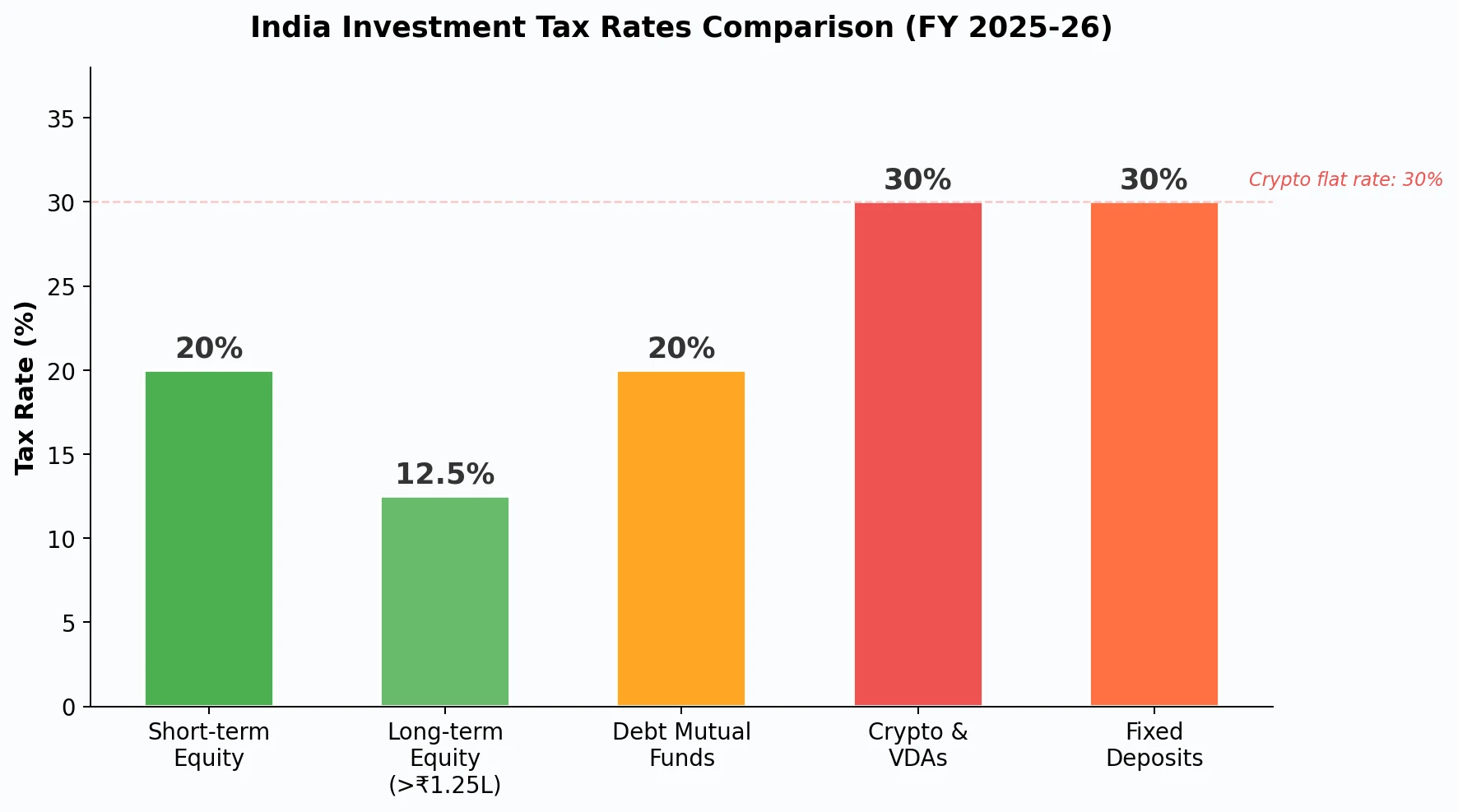
To understand why tax planning is not optional for crypto investors, consider a practical example. An investor who bought Bitcoin at ₹50,000 per unit and sold at ₹75,000 makes a ₹25,000 gain per unit. After the 30% tax plus cess, the effective tax rate comes to approximately 31.2%, leaving a net gain of roughly ₹17,200 per unit.
Now compare this to equity. The same ₹25,000 gain on a listed stock held for more than 12 months would be taxed at 12.5% (long-term capital gains above ₹1.25 lakh), and the investor could offset losses from other stock trades. The effective post-tax gain on equity would be approximately ₹21,875 — 27% more than the crypto investor keeps.
This tax differential means that crypto investors need to generate significantly higher pre-tax returns just to match the after-tax performance of equity investments. And this is where the choice of trading tools becomes a tax planning decision, not just a trading decision.
How AI Forecasting Tools Change the Tax Equation
The connection between trading tools and tax outcomes is not immediately obvious, but it is substantial. Here is why.
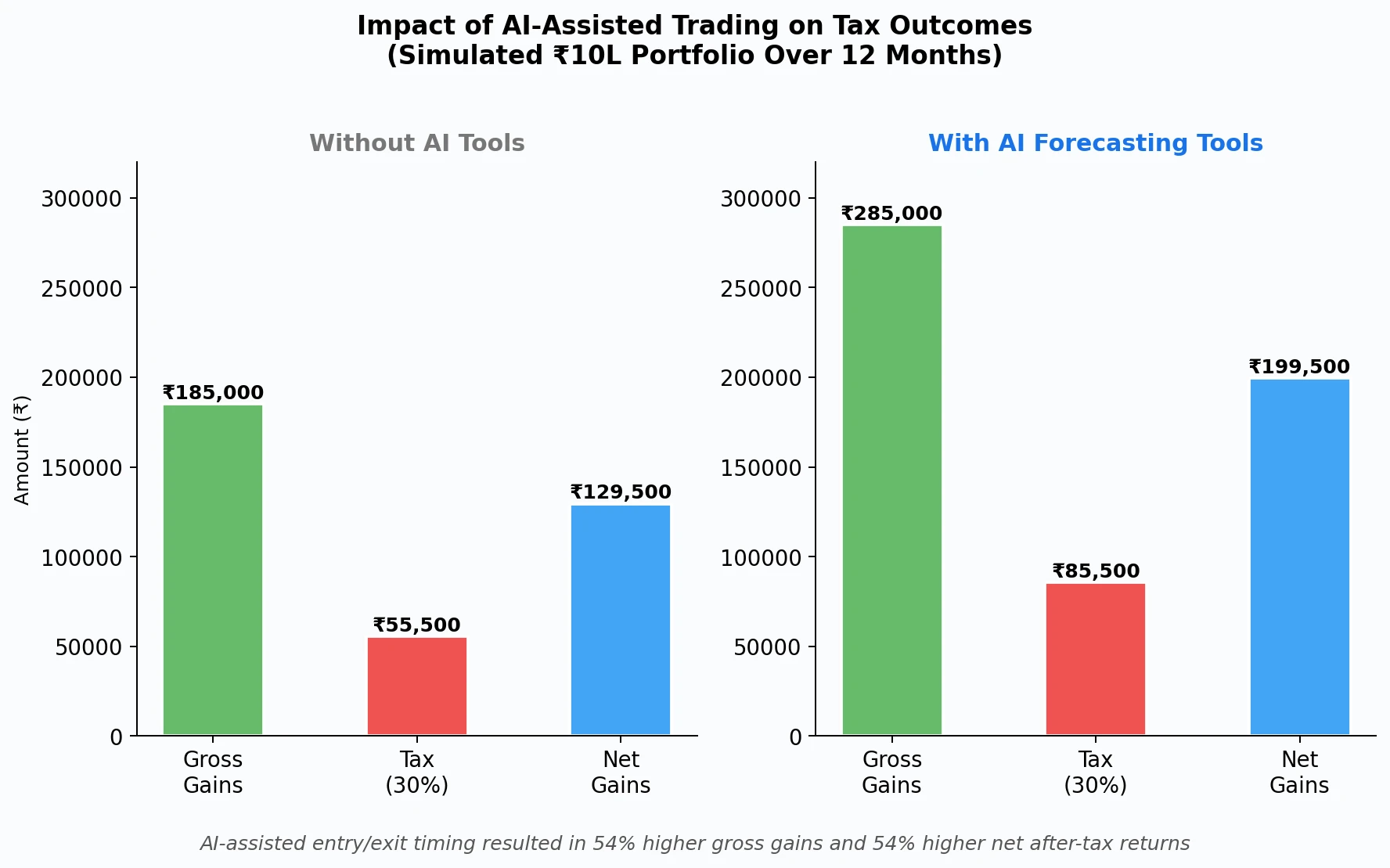
Under India’s no-loss-offset rule, every losing trade is a pure tax loss — it reduces your capital without generating any tax benefit. In equity markets, a loss on one stock can be set off against gains on another, so losing trades at least provide tax relief. In crypto, they do not. This means that reducing the frequency and magnitude of losing trades has an outsized impact on after-tax returns for Indian crypto investors compared to investors in any other asset class.
This is where AI-powered forecasting tools provide measurable value. Research published in Frontiers in Artificial Intelligence has shown that ensemble machine learning models — combining LSTM neural networks with gradient boosting algorithms — achieve directional accuracy above 82% on cryptocurrency price predictions. For an Indian investor, that accuracy translates directly into fewer losing trades, which under Section 115BBH’s harsh rules, means substantially better after-tax outcomes.
Modern platforms offering AI-driven crypto forecasts do not just predict whether prices will go up or down. They provide probability distributions — for example, a 72% probability that Bitcoin will trade between $68,000 and $73,000 over the next seven days. This kind of probabilistic output allows investors to size their positions according to confidence levels, reducing exposure on low-conviction trades and concentrating capital on high-probability setups.
For Indian investors filing ITR, the practical benefit is clear: fewer transactions, higher win rate, and larger average gains per trade — all of which reduce the effective tax burden under a regime where every loss is permanent.
Five Tax Planning Strategies for Crypto Investors in 2026
Within the current legal framework, here are the most effective approaches to minimising your crypto tax liability:
Common Filing Mistakes to Avoid
Based on assessment notices issued by the Income Tax Department in FY 2024-25, the most common errors in crypto ITR filing are:
Looking Ahead: What May Change
The Indian crypto tax framework is likely to evolve over the next 12–24 months. The government’s own data shows that the current harsh regime has pushed trading volume offshore and reduced domestic exchange revenue, which in turn reduces TDS collection and tax compliance visibility. The Reserve Bank of India’s CBDC pilot (now covering 5.2 million users) may also influence how digital assets are classified and taxed.
For now, the prudent approach is to operate within the existing rules while building systems — including AI-powered analysis tools, tax tracking software, and professional advisory relationships — that will allow you to adapt quickly when the framework changes. The investors who will benefit most from any future tax relief are those who maintained clean, complete records throughout the current regime.
The 30% rate is steep. The no-offset rule is painful. But with disciplined planning, the right tools, and meticulous documentation, Indian crypto investors can still build meaningful after-tax wealth — and be well-positioned to benefit when the regulatory environment inevitably matures.

 Register & Login