 F-14/15, Orbit Mall, Civil Lines, Jaipur-302006
 support@thetaxheaven.com
F-14/15, Orbit Mall, Civil Lines, Jaipur-302006 support@thetaxheaven.com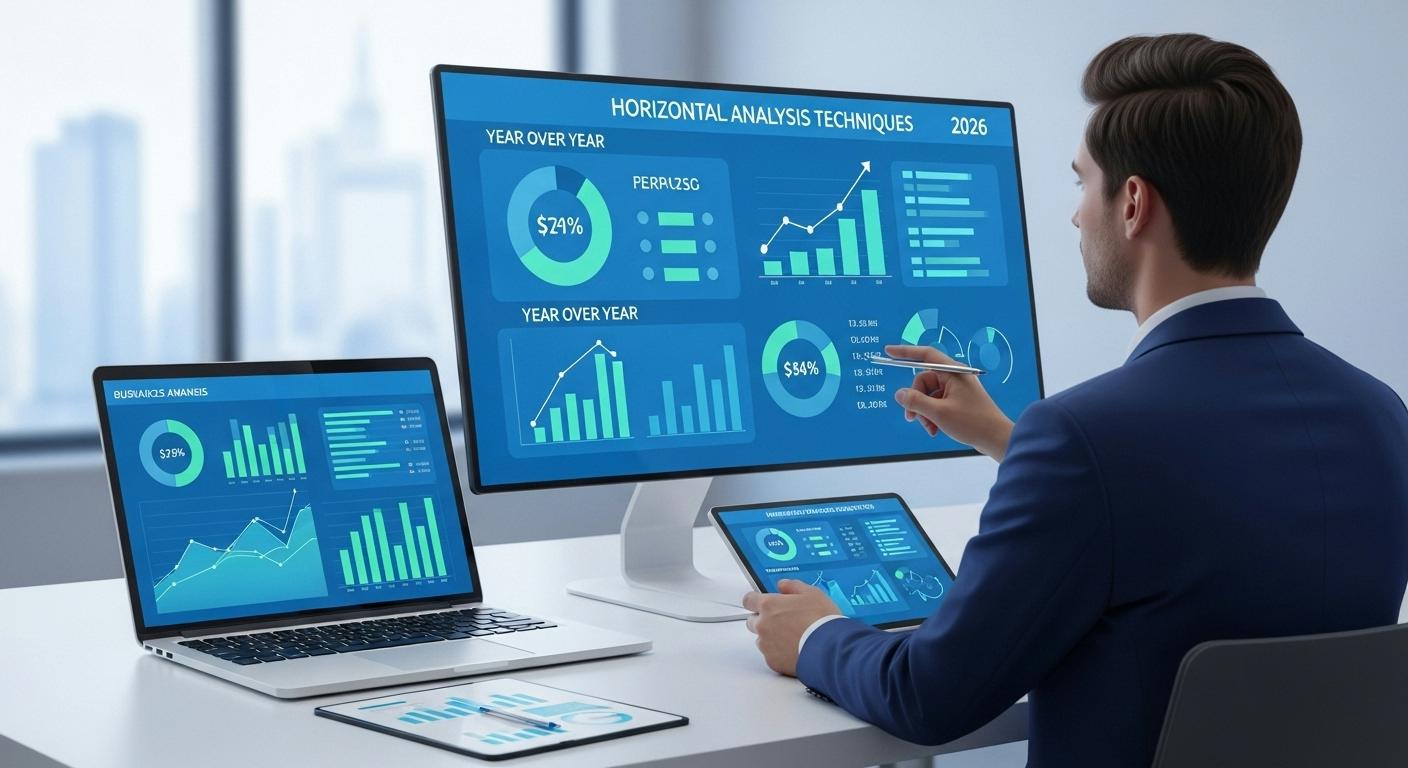
Financial analysis in 2026 is rapidly transforming as businesses adopt AI-driven tools, automation, and real-time financial reporting. Horizontal analysis remains one of the most practical techniques for assessing financial performance because it focuses on trends over time rather than isolated financial data.
Today, the use of horizontal analysis along with predictive analytics and business intelligence tools has become standard among modern finance teams in order to understand the revenue, expenses, and profitability in a deeper way.
Analysing financial changes over time enables organisations to make informed decisions, create opportunities to grow, and minimise financial risks within the ever-growing competitive environment. The article describes how the horizontal analysis methods are applied in 2026 to measure the financial performance by comparing data from various periods.
This article discusses five major approaches that are improved through AI automation and real-time solutions to allow businesses to determine tendencies and predict performance and make decisions based on data.
● Horizontal analysis involves the comparison of the financial data of more than two periods to find out the growth trends, downturns, and other abnormal financial developments.
● Year-on-year comparisons are easy to prepare in financial reports because they indicate the percentage increase or decrease between reporting years.
● In financial analysis, AI-driven analytical software automates calculations and minimises human errors, increasing the speed and accuracy of the analysis.
● Trend analysis assists businesses in making predictions about how they are going to perform in the future in terms of revenue, cost, and profit-making by tracking certain patterns.
● The comparison with industry competitors highlights performance gaps and where changes are specific to the company or driven by the market.
● Variance analysis, which clarifies why financial changes occurred, assists organisations in determining the cost growth, revenue variations, or poor operations.
● Cloud-based platforms enable real-time horizontal analysis, letting companies track performance more frequently than with annual reviews.
Horizontal analysis evaluates financial performance by comparing data across two or more reporting periods. By focusing on changes and trends rather than a single year’s figures, this approach helps organisations track growth, stability, and potential risks.
It enables companies to follow the development of income, costs, and profits. Automation and real-time reporting devices have made horizontal analysis more powerful in 2026. It is a tool used by the finance professionals who make proactive decisions as opposed to using reviews of past performance as a sole basis.
The aims of horizontal analysis are aimed at assisting organisations in the realisation of how their performance varies with time in terms of finances. It helps to make informed decisions and financial planning over the long term by comparing data between periods.
● Keep track of the revenue and profit trends to be aware of the trends of the financial growth.
● Assess operational efficiency by analysing changes in costs and expenses.
● Support budgeting and forecasting by utilising the comparison of financials over the long term.
The five most suitable horizontal analysis methods in 2026 that will be used in evaluating finances are those that use comparative analysis of financial data over different timeframes to reveal the trend, growth and possible risks. These methods enable organisations to measure the change in revenue, cost behaviour, and profitability more precisely through the assistance of AI-based analytics, real-time reporting and automation.
Businesses can use percentage change analysis, trend analysis, comparative statements, index numbers, and benchmarking together to gain a deeper understanding of their operations. Consequently, these combined methods improve strategic planning, forecasting, and overall performance. Students studying finance or preparing reports can also rely on an assignment writing service based in London to structure their analyses, interpret data, and present findings effectively.
Trend line analysis is a horizontal analysis method that analyses a series of financial data to determine similar patterns and general trends. When businesses can visualise the trends of key metrics (revenue, expenses, or profits) over some years, they can notice the growth patterns or the decline.
● Trend line analysis gives a clear picture of changes in the financial metrics with time, which assists organisations in identifying valid trends and in making well-informed decisions. It is particularly helpful in future performance projections and strategic planning.
● Determines regular patterns and trendy changes in revenues, expenditures, and profits.
● Helps make predictions of the future based on the trends of historical data.
● Favours the planning and proactive financial decision-making.
● Identifies seasonal variations or regular financial trends to improve knowledge of operations.
To further demonstrate the trend line analysis using a practical example, the following table demonstrates a simple example of the revenue trends in three years. It shows the trend of growth and assists in visualising the regular trends to aid in forecasting and strategy formulation.
|
Year |
Revenue ($) |
Trend Observation |
|
2023 |
500,000 |
Baseline |
|
2024 |
550,000 |
Upward trend |
|
2025 |
610,000 |
Continued growth |
One of the most common types of horizontal analysis is percentage change analysis which can be used to evaluate financial performance over time. It is the degree to which a particular financial amount like revenue expenses or net profit is growing or reducing relative to a prior reporting period.
The technique expresses financial changes in percentages, making them easy to understand for all stakeholders.
This method uses a base period as the reference and compares later periods to it. The finance teams compute the percentage difference in order to determine the improvement or deterioration.
These calculations are automatically done in 2026 with advanced accounting software and AI-powered analytics tools that minimise the amount of manual effort and reduce accounting errors. This will enable organisations to review financial performance more often as opposed to once a year.
The percentage change analysis contributes to the management in very little time in identifying abnormal changes in the revenue costs or profits. Massive gains can mean a working strategy or expansion of the market, and drastic drops can denote ineffective operations or vulnerability of finances. The method is particularly useful in short-term evaluation of performance and comparisons of years-on-years in which timely data is essential.
Organisations apply percentage change analysis to control sales growth, manage operating expenses, and evaluate profitability trends. Moreover, investors and lenders use this method to assess financial stability and identify growth opportunities. Other horizontal analysis methods coupled with it give it a solid basis in predicting budgeting and strategic planning.
The comparative financial statement analysis entails the examination of the financial statements of two or more periods against each other to determine the change in the financial performance. The comparison of income statements, balance sheets, and cash flow statements enables organisations to identify areas to be improved and those that have inefficiencies.
This is a way of enabling finance individuals to assess the impact of operational decisions on financial results in the long run. The comparison with the ERP systems and automated reporting tools is quicker and more precise in 2026. This is a technique that has been adopted by businesses to enhance budget, financial planning performance, and operations.
Collective analysis of financial statements compares the organisations performances in terms of financial capacity by comparing and contrasting various reporting periods. This method helps management track revenue, expenses, and profits over time to make informed decisions and identify key investment areas.
● Makes comparisons of financial statements made in various periods with a detailed analysis that helps organisations to show the progress in terms of revenue, expenses, and profitability over time.
● Determines the strengths and weaknesses of the operation by direct comparison that enables the management to know areas that require improvement or outlay.
● Helps to make decisions based on data and enhance financial planning with actionable insights that can be used to guide a budget, forecast, and initiatives.
The index number analysis is an influential financial tool that transforms unstructured financial information into indexed figures in comparison to a base year. This process standardises the figures, which enables the organisation to monitor and compare the performance over several years clearly and consistently.
Nowadays, this analysis is commonly automated in digital finance environments. Additionally, data visualisation dashboards instantly calculate and display index values, making long-term financial monitoring more effective and accessible for strategic decision-making.
● It makes difficult, long-term financial comparisons easy as it removes the distraction of large absolute numbers.
● The indexed values have a clear emphasis on the growth trends, trends and comparative performance change.
● The method is part of strategic planning and aids stakeholders in picturing the directions and making decisions based on data.
Benchmark-based analysis compares an organisation’s financial trends with industry averages or competitors to evaluate market performance. This method helps businesses identify their strengths and weaknesses relative to others in the same sector.
A study by PwC Global Benchmarking revealed that organisations that operate with benchmarking attain operational efficiency up to 15%, which is why it is strategic. Finance teams are able to make more informed strategic decisions by utilising both internal trend analysis and comparing it with external comparisons. Benchmarking also assists organisations in determining the areas of gap in performance and areas of improvement.
As an example of using trend analysis in practice, we will take the following analysis on a horizontal (year-over-year) analysis. The following table will compare the major line items of financial information in 2024 and 2025 and calculate the percentage change and absolute change of the items to demonstrate the performance trend.
|
Financial Item |
2024 |
2025 |
Change |
% Change |
|
Revenue |
$500,000 |
$600,000 |
+$100,000 |
20% |
|
Operating Expenses |
$300,000 |
$330,000 |
+$30,000 |
10% |
|
Net Profit |
$200,000 |
$270,000 |
+$70,000 |
35% |
Good horizontal financial analysis needs proper data, the same accounting practices and significant periods of comparison. Financial professionals must pay attention to the financial changes and not the smaller fluctuations to have the relevant information. The integration of the various methods of analysis gives a better picture of the financial performance.
Organisations should interpret financial trends within economic and industry contexts. This approach helps prevent misleading conclusions and supports more accurate decision-making. The use of clear reporting including visual charts and brief explanations assists the stakeholders in comprehending the traits of major findings.
The field of horizontal financial analysis is changing as the technology of artificial intelligence, automation, and predictive analytics improves. Financial organisations now rely on AI-driven tools to identify anomalies and predict financial results, a shift that also shapes how UK assignment writing services explain complex accounting concepts to students. Real-time financial dashboards enable organisations to have a real-time performance tracker.
Financial changes are automatically brought to the fore through automated variance analysis. These tendencies are changing horizontal analysis from a retrospective instrument to a proactive approach towards financial planning.
● AI and machine learning improve financial forecasting by leveraging historical data and forecasting future financial trends more accurately.
● Live dashboards offer performance monitoring in real-time, enabling finance departments to monitor key financial metrics in real-time and make quicker and more evidence-based decisions.
● Automation eliminates human errors in reporting and calculations, increases efficiency and saves manual analysis time by streamlining repetitive financial operations.
Horizontal analysis continues to be a crucial instrument for evaluating financial performance in 2026, which offers insights to organisations that may be useful in terms of trends, risks, and growth prospects. The use of percentage change analysis, trend line analysis, comparative financial statements, index number analysis, and benchmark-based comparisons helps businesses make informed decisions. Moreover, these techniques allow organisations to analyse data effectively and identify trends, ensuring that every decision is grounded in solid evidence.
Horizontal financial analysis becomes more efficient and insightful when organisations integrate AI analytics, automation, and real-time dashboards. Consequently, businesses can monitor performance continuously and make faster, data-driven decisions. With these progressive practices, organisations are able to enhance strategic planning, operational efficiency and attain sustainable financial success.
Horizontal analysis involves comparisons of financial information of two or more periods to analyse the growth trends and financial stability. It assists in showing organisations the trends of revenue, expense, and profits as they vary with time. This approach emphasises business strengths and risks that may occur in the business. It can be used to enhance strategic planning and forecasting by finance teams. Overall, trend-based information helps improve financial decision-making.
Horizontal financial analysis involves consideration of financial trends over a series of reporting periods whereas vertical analysis looks at a single item of finances in a particular period. In vertical analysis, analysts express data as a percentage of totals, while horizontal analysis measures changes over time. Together, these two methods provide a comprehensive view for financial analysis. Horizontal analysis determines the growth trends, and vertical analysis indicates the cost structure. Combined with each other, they offer a well-rounded perspective of financial performance.
Current finance departments deploy AI analytics software, ERP, and Excel, as well as business intelligence dashboards. Cloud accounting is a type of software that allows moving the financial monitoring and automated reporting into real-time. Financial graphs can be displayed in graphic representations by the use of visualisation tools. Predictive analytics enhances the accuracy of forecasting and decision-making. These technologies ease the analysis and transform financial insights into actionable ones.

 Register & Login